Your client judges the formatting before they judge the craft
Before principal photography, every piece of evidence a client has about your company is a document. Most of them were formatted at 11pm by whoever was awake.
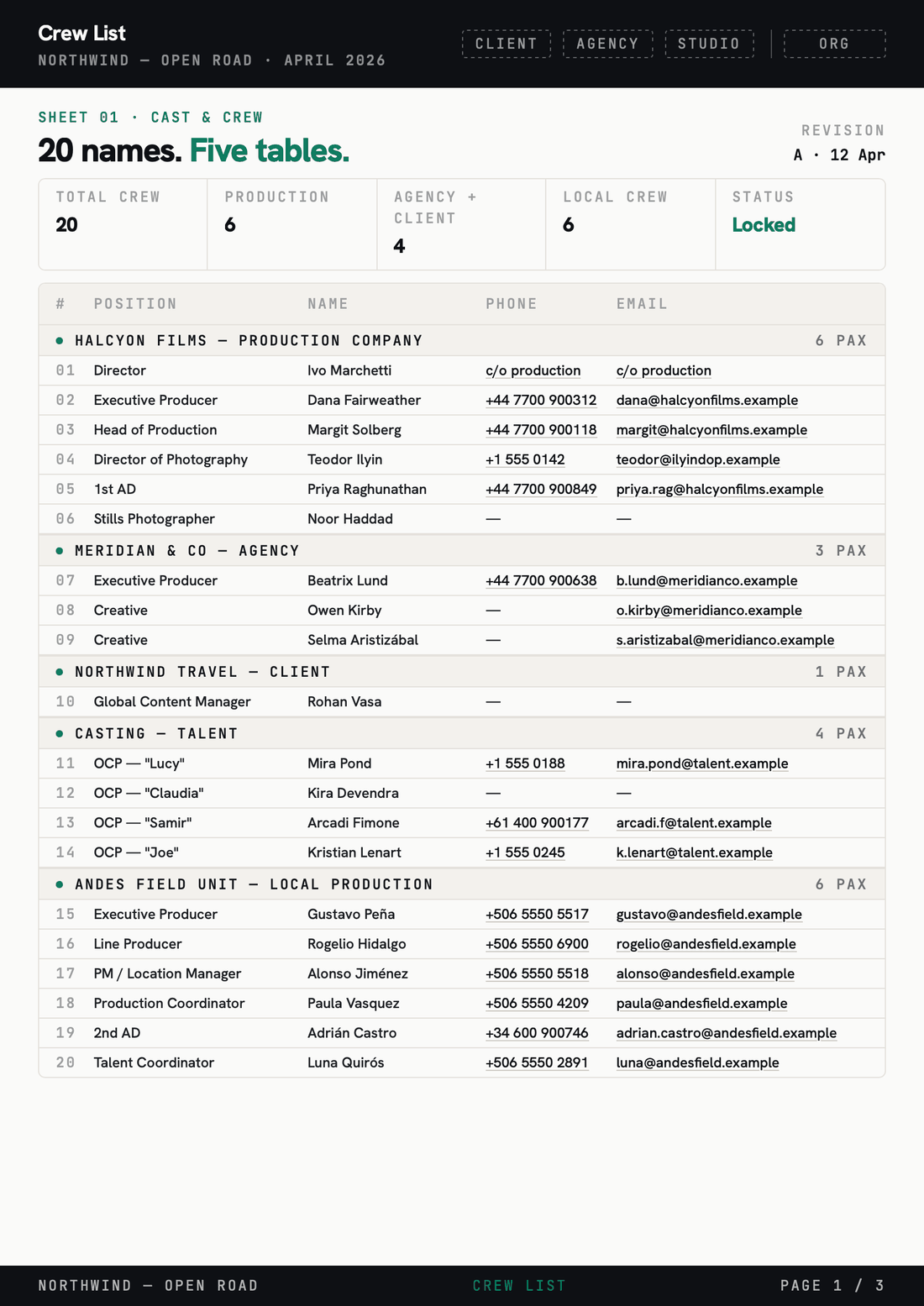
Think about the sequence from the client's side. They award the job. Then, for somewhere between three weeks and three months, they receive documents. A schedule. A crew list. A location package. A welcome pack. Movement orders. Budgets and cost reports.
Not one frame has been shot. Every judgement they are forming about whether they chose the right company is being formed from paperwork.
The documents are the company
Producers know this instinctively and rarely say it out loud, because it feels like it should not be true. The craft is the work. The paperwork is admin.
But a client cannot assess your craft yet. They can assess whether your documents arrive on time, whether they are internally consistent, whether the location address on the movement order matches the one in the welcome package, and whether the whole set looks like it came from one company. Those are the only signals available, so those are the signals they use.
And in most service companies that entire impression rests on whoever happened to be building the file the night before. A coordinator with a good eye produces a beautiful document. The same company, on a different job with a different coordinator, produces something visibly different. The client experiences that as inconsistency, and inconsistency reads as disorganisation whether or not the production is actually disorganised.
Style is an organisation setting, not a document choice
The fix is to move the decision up a level. The way documents look should be set once, for the company, and apply to everything the company issues.
This sounds restrictive and is the opposite. A per-document style picker means every export is a small design decision made by someone who is not a designer and is in a hurry. The result is a project whose paperwork arrives in three different formats, which is exactly the impression you were trying to avoid. Choosing once, at the organisation level, removes the decision from the moment where it is most likely to be made badly.
What is worth having is a small number of coherent options rather than infinite control — a neutral default for internal and general use, something more considered for client-facing work, and something hard-edged and legible for documents that get printed and handled on set. Three real choices, made once.
Whose logo is on it
On a service production there are usually three parties with a claim to the header: the agency, the production company, and the client. Which of them appears, in what order, is a per-project fact, and getting it wrong is a small diplomatic incident.
This is worth setting once per project and stamping automatically, for a simple reason: it is the kind of task that is easy to remember on the first document and easy to forget on the eleventh. Automatic branding is not about saving the thirty seconds. It is about removing the possibility of the version that went out without it.
What a client should see, and what they should not
The other half of this is the client's own window into the work. They should be able to open a link and see the current state — no account, no password, no software to install. Asking a client to create a login to look at a travel schedule is asking them to do your production's administration.
Equally, that window has to be unmistakably read-only. Not merely non-functional, but visibly a view: no controls that look like they might do something, no ambiguity about whether they are seeing a draft or the current version. And the link has to be revocable, with the consequences of revoking it stated plainly, because relationships change and access should be able to change with them.
The states nobody designs are the ones that matter most here. A client who follows a link before there is anything to show should land somewhere reassuring that explains what will appear and when. That is a fairly common moment — clients are keen early — and it is a bad one to handle with an error page.
The cheapest professionalism available
None of this improves the work. The shoot is the shoot. But the gap between a company whose paperwork is consistently, automatically correct and one whose paperwork depends on who was awake is enormous, it is visible from the outside, and it costs almost nothing to close once the underlying records are in one place.
It is the cheapest professionalism a service company can buy, and most of them are still paying for it in coordinator hours at midnight.